
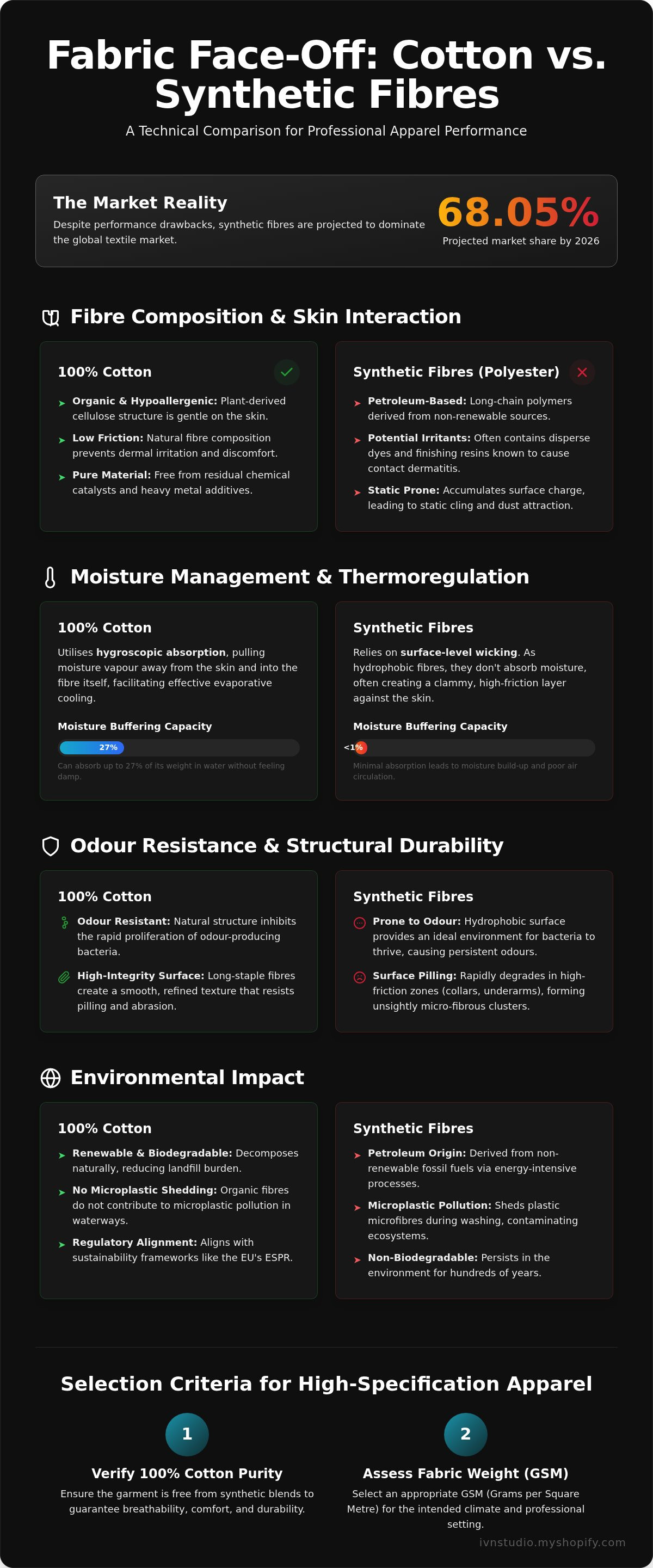
Synthetic fibres are projected to hold a 68.05% share of the global textile market in 2026, yet this industrial dominance often prioritises manufacturing cost over wearer physiological comfort. The decision process regarding cotton vs synthetic shirts requires a detailed assessment of complex interactions between moisture-wicking capabilities, bacterial growth resistance, and long-term structural integrity. You likely recognise the recurring frustration of persistent odour retention and dermal irritation inherent in petroleum-derived polyester garments.
This article provides a pragmatic evaluation of fibre characteristics, thermoregulation efficiency, and structural durability to facilitate informed professional apparel selection. We examine the technical superiority of 100% cotton long-sleeved polo shirts, focusing on material purity, high-specification breathability, and functional design requirements. The following analysis details heat dissipation mechanisms, material degradation rates, and the specific advantages of natural cellulose fibres for daily smart-casual dress codes. Expect a data-driven comparison of textile performance standards and material longevity metrics to ensure optimal garment utility and wearer health.
Key Takeaways
- Contrast natural cellulose molecular structures with petroleum polymers to identify the primary causes of dermal irritation and skin-contact friction.
- Compare vapour permeability and hygroscopic capacity in cotton vs synthetic shirts to optimise physiological thermoregulation and air circulation.
- Assess resistance to surface pilling and abrasion in high-friction zones to ensure long-term structural durability and professional aesthetic presentation.
- Utilise fabric weight (GSM) and 100% cotton purity identification as primary metrics for selecting high-specification apparel suitable for professional environments.
- Follow technical maintenance protocols to preserve fibre colour retention and garment shape stability throughout the product lifecycle.
Fibre Composition and Physical Properties Analysis
The technical differentiation between cotton vs synthetic shirts begins at the macromolecular level; it contrasts the organic structure of plant-derived cellulose with the long-chain synthetic polymers of petroleum origin. Natural cotton consists of approximately 90% cellulose, a complex carbohydrate that provides inherent structural stability and a low skin-contact friction coefficient. This organic composition ensures a hypoallergenic interface, as natural fibres lack the residual chemical catalysts and heavy metal additives common in polymer extrusion processes. Comparisons regarding cotton vs synthetic shirts frequently highlight the presence of disperse dyes and finishing resins in polyesters, which are known factors in triggering contact dermatitis and dermal irritation during extended professional wear.
Natural Cellulose Fibre Characteristics
Natural cellulose fibres exhibit high tensile strength and a natural twist that facilitates superior spinning and weave density. These physical properties allow for the production of 100% cotton long-sleeved polo shirts that maintain structural integrity without the necessity for elastane or other synthetic reinforcements. Key technical advantages include:
- Absence of static electricity: Natural cotton does not accumulate surface charge, preventing the discomfort of static cling and dust attraction.
- Inherent biodegradability: Organic cotton fibres decompose naturally, aligning with the EU's Ecodesign for Sustainable Products Regulation (ESPR) effective from July 2026.
- Material purity: The use of 100% cotton eliminates the risk of microplastic shedding, a critical consideration as global textile regulations become increasingly stringent.
Synthetic Polymer Composition
Synthetic polymer compositions, predominantly polyester and nylon, are characterised by a hydrophobic molecular nature that fundamentally restricts moisture absorption. With synthetic fibres projected to hold a 68.05% market share by 2026, the environmental and physiological impact of these petroleum-derived filaments is a primary concern for the rational consumer. Polyester filaments require intensive chemical treatments to achieve basic moisture management, yet these coatings often degrade after limited laundering cycles. Furthermore, the hydrophobic nature of these plastics facilitates the rapid proliferation of odour-producing bacteria, a failure of material performance that is absent in high-specification natural textiles.
Fibre length serves as a critical determinant of garment surface smoothness and tactile comfort. High-specification 100% cotton long-sleeved polo shirts utilise long-staple fibres to create a refined texture that resists surface pilling and mechanical abrasion. Conversely, low-quality synthetic blends often suffer from rapid degradation of surface integrity; this leads to the formation of micro-fibrous clusters in high-friction zones such as the underarms and collar. The selection of natural fibres ensures a consistent aesthetic presentation and superior durability for professional environments.
Thermoregulation and Moisture Management Efficiency
Thermoregulation efficiency in professional environments depends on the interaction between textile vapour permeability and the body's latent heat of evaporation. Analysis of cotton vs synthetic shirts reveals a fundamental divergence in moisture management strategies: hygroscopic absorption versus capillary wicking. Cotton fibres possess a natural lumen; this internal cavity allows for the absorption of water vapour up to 27% of their own weight without the material feeling damp to the touch. Synthetic polymers, being fundamentally hydrophobic, rely on surface-level wicking which often fails to facilitate sufficient air circulation in static office environments. This lack of gas exchange creates a restricted microclimate against the dermis, increasing skin temperature and subsequent perspiration rates.
Technical evaluations of heat retention properties indicate that cotton maintains a stable thermal profile in dry states whilst providing effective evaporative cooling when damp. In high-humidity professional settings, the latent heat of evaporation is managed through the fibre’s natural moisture-buffering capacity. Synthetics often experience a total collapse in air-gap insulation when saturated; this results in a clammy, high-friction interface that compromises both physical comfort and professional composure. The reliance on natural fibres ensures a predictable physiological response to temperature fluctuations throughout the working day.
Breathability and Airflow Dynamics
The natural pore structure of cellulose fibres ensures superior gas exchange compared to the non-porous extruded filaments of polyester or nylon. Air circulation metrics for 100% cotton weaves demonstrate high levels of vapour permeability; this allows metabolic heat to dissipate effectively through the fabric matrix. High-density synthetic knits often act as unintentional thermal barriers, trapping humid air and necessitating chemical cooling finishes that lack long-term durability. For professionals prioritising consistent thermal regulation, selecting a high-specification 100% cotton polo shirt provides a reliable mechanism for skin temperature maintenance during extended wear.
The "Odour Trap" and Bacterial Proliferation
Bacterial adhesion represents a significant performance failure in petroleum-based garments. Hydrophobic synthetic surfaces provide an ideal substrate for the proliferation of Micrococcus bacteria; these microorganisms metabolise long-chain fatty acids in sweat into volatile, malodorous compounds. Cotton’s hygroscopic nature facilitates the sequestration of these acids within the fibre core, preventing immediate bacterial breakdown and surface-level odour emission. During standard laundering cycles, the swelling of cellulose fibres in water allows for the total release of trapped odour molecules. Synthetics often retain these compounds within the polymer matrix, leading to persistent odours even after high-temperature washing. This technical distinction ensures that natural fibre shirts maintain freshness for significantly longer durations than polyester alternatives.
Structural Integrity and Long-term Durability Assessment
Long-term structural integrity evaluation of cotton vs synthetic shirts reveals distinct patterns of material fatigue and surface-level degradation. Resistance to mechanical wear is a primary determinant of garment lifecycle value in professional environments. Cotton fibres demonstrate superior surface stability against repetitive friction, whilst petroleum-derived polymers often exhibit rapid textural changes. High-frequency laundering cycles further accelerate these processes, necessitating a technical understanding of fibre response to thermal and chemical stress. Colour retention and dye absorption stability represent additional metrics where natural cellulose often outperforms synthetic alternatives due to deep-core pigment integration.
Pilling and Surface Degradation
Synthetic filaments possess high tensile tenacity, which prevents individual fibres from breaking away during mechanical abrasion. This characteristic leads to the formation of surface pills; these are small, unsightly bobbles caused by entangled fibres that remain anchored to the fabric surface. Cotton fibres exhibit a lower breaking tenacity; this allows exhausted fibres to shed cleanly rather than entangling. Technical advantages of 100% cotton in professional smart-casual wear include:
- Reduced static-induced lint attraction: Natural fibres don't generate the surface charge that attracts atmospheric particles.
- Maintained surface smoothness: The absence of pilling ensures a consistent professional aesthetic over extended usage periods.
- Enhanced visual longevity: Natural textiles retain a matte, high-specification finish without the artificial sheen common in aged polyester.
Tensile Strength and Tear Resistance
Load-bearing capacity and stitch retention are critical for seam durability in professional apparel. Whilst polyester threads offer high initial tensile strength, they're susceptible to polymer chain fragmentation when exposed to UV radiation. Prolonged sunlight exposure causes synthetic polymers to become brittle, significantly reducing tear resistance over time. Cotton fibres remain UV stable, maintaining their physical properties even in high-exposure environments. Dimensional stability remains a concern for natural fibres; however, proper maintenance protocols effectively manage potential shrinkage. High-temperature laundering poses a greater risk to synthetics through thermal distortion and the permanent loss of garment shape. Selection of high-specification cotton ensures a stable, durable garment that resists the environmental degradation factors affecting petroleum-based materials.
Professional Application and Maintenance Requirements
Aesthetic presentation in business environments is determined by fibre light-reflectance properties and surface texture. Cotton vs synthetic shirts differ significantly in visual quality; natural cellulose provides a matte, crisp appearance whilst petroleum polymers often exhibit a characteristic artificial sheen. This sheen becomes more pronounced under artificial office lighting, often perceived as a lower-tier material standard. Stain removal efficiency also varies; cotton's absorbent nature allows for deep-cleaning of water-based stains, whereas synthetic surfaces often trap oil-based pollutants within the polymer matrix, leading to permanent discolouration. Professional-grade appearance requires materials that maintain visual consistency regardless of environment.
Smart-Casual Dress Code Standards
The integration of men’s long-sleeved cotton polo shirts into professional wardrobes facilitates a balance between functional comfort and formal aesthetic requirements. Visual texture differences are immediately identifiable; the high-density piqué or jersey knits of 100% cotton provide a structural depth that synthetic blends cannot replicate. Colour palette stability remains a critical factor. Natural fibres absorb reactive dyes into the core, ensuring consistent appearance across different lighting conditions without the metamerism issues common in polyester filaments. This ensures the garment retains its intended hue throughout its functional lifecycle.
Efficient Maintenance Strategies
Preserving the structural integrity of high-specification apparel requires adherence to specific thermal and mechanical laundering protocols. Optimising wash temperatures is essential for the benefits of 100% cotton preservation, specifically regarding fibre elasticity and colour density. High-temperature drying should be avoided to prevent cellulose fibre embrittlement. Recommended maintenance steps include:
- Temperature regulation: Wash at 30-40°C to minimise thermal stress and prevent dimensional shrinkage.
- Mechanical protection: Launder garments inside out to protect the outer surface from drum abrasion and pilling.
- Storage protocols: Use wide-profile hangers or flat-fold methods to maintain collar structure and prevent shoulder distortion.
Ironing and steaming requirements for professional-grade appearance are more demanding for natural fibres, yet the result is a superior, long-lasting crispness. Cotton responds predictably to steam, allowing for the rapid removal of transit creases and the setting of sharp lines. Synthetics pose a risk of thermal melting or surface glazing if ironed at incorrect temperatures. For professionals seeking a reliable, high-specification wardrobe, you can purchase 100% cotton long-sleeved polo shirts to ensure consistent aesthetic performance and durability.
Selection Criteria for High-Quality Cotton Apparel
Pragmatic apparel selection for professional environments requires a systematic evaluation of material purity and structural specifications. The primary identifier of garment performance remains the 100% cotton label; this ensures the absence of petroleum-derived polymers that compromise thermoregulation. When assessing cotton vs synthetic shirts, the technical focus shifts to fabric weight, measured in grams per square metre (GSM). A higher GSM value, typically ranging from 180 to 220 for polo shirts, indicates a denser weave suitable for transitional seasons and enhanced structural longevity. Conversely, lower GSM values provide optimal breathability for high-temperature climates. Understanding these metrics allows for precise procurement aligned with specific environmental and seasonal demands.
Technical Quality Indicators
Objective construction quality assessment involves the inspection of thread uniformity and weave consistency across the entire garment surface. Premium cotton textiles exhibit minimal slubbing and high surface smoothness, directly impacting long-term durability. Key performance markers include:
- Stitch density: High stitches-per-inch (SPI) counts ensure seam stability and resistance to mechanical stress at high-tension points.
- Collar stability: High-specification interfacing prevents structural collapse after repeated laundering, maintaining professional aesthetic standards.
- Component integrity: Secure button attachment and reinforced plackets indicate superior manufacturing standards.
Evaluation of the hand-feel provides immediate data regarding fibre length and finishing processes. Premium long-staple cotton produces a soft, low-friction texture that remains stable throughout the product lifecycle. This material choice prevents the dermal irritation frequently associated with lower-grade synthetic filaments.
Procurement and Ordering Efficiency
Effective online apparel selection depends on the availability of detailed technical specifications rather than subjective descriptions. Rational consumers prioritise material-first analysis to ensure sizing consistency and functional utility. The economic logic of investing in high-durability natural materials is based on the reduced frequency of replacement and superior professional presentation. Long-term cost-per-wear metrics favour high-specification cotton over low-cost synthetics due to the inherent resistance to pilling and thermal distortion. Selecting 100% cotton long-sleeved polo shirts provides a predictable performance profile, eliminating the risks associated with rapid degradation and odour retention in synthetic blends. Final wardrobe optimisation relies on the identification of verified material standards and construction excellence. This methodical approach to procurement ensures maximum utility and wearer comfort in smart-casual business settings.
Optimising Professional Apparel Selection Through Material Purity
Technical evaluation of cotton vs synthetic shirts confirms the physiological and aesthetic superiority of natural cellulose fibres for professional environments. The high hygroscopic capacity of cotton ensures efficient thermoregulation whilst the absence of petroleum-derived polymers prevents dermal irritation and persistent odour retention. Investing in high-density technical weaves provides a stable professional presentation that resists the surface pilling and thermal distortion common in synthetic alternatives. These material characteristics translate into a lower cost-per-wear and a consistent smart-casual appearance across varied lighting conditions and high-frequency laundering cycles.
Adherence to 100% natural cotton composition standards ensures a reliable, high-specification wardrobe suitable for modern business requirements. Material-first procurement strategies prioritise construction quality markers such as stitch density and collar stability to maintain garment shape over time. Purchase Men’s 100% Cotton Long-Sleeved Polo Shirts to secure a professional smart-casual aesthetic with guaranteed material durability and high-density technical weave performance. Rational apparel choices result in long-term utility and superior wearer comfort throughout the working day.
Frequently Asked Questions
Is 100% cotton better than polyester for daily office wear?
100% cotton is superior for daily office wear due to its hygroscopic capacity and matte finish. When evaluating cotton vs synthetic shirts, natural cellulose facilitates continuous vapour permeability, preventing the accumulation of metabolic heat in static indoor environments. This material choice ensures a professional appearance without the artificial sheen common in petroleum-derived textiles. The result is improved physiological comfort during extended periods of sedentary activity.
Do synthetic shirts cause more body odour than cotton ones?
Synthetic shirts facilitate higher levels of body odour because hydrophobic surfaces encourage the adhesion of Micrococcus bacteria. These microorganisms metabolise sweat components into malodorous volatile compounds that often remain trapped within the polymer matrix. Cotton sequesters these molecules and releases them completely during standard laundering cycles, maintaining freshness for longer durations. This technical distinction makes natural fibres preferable for maintaining professional hygiene standards.
What are the main benefits of 100% cotton for sensitive skin?
The primary benefits of 100% cotton for sensitive skin include its hypoallergenic molecular structure and low skin-contact friction coefficient. Natural cellulose fibres are devoid of residual chemical catalysts and heavy metal additives found in synthetic filaments. This material purity reduces the risk of contact dermatitis and dermal irritation during extended professional wear. It provides a safer interface for individuals prone to non-breathable material sensitivities.
How does the durability of cotton compare to synthetic blends?
High-specification cotton provides superior surface durability by resisting the pilling and bobbling characteristic of synthetic blends. Whilst polyester threads possess high initial tensile tenacity, they're susceptible to UV-induced polymer fragmentation. Natural fibres maintain structural integrity and visual longevity without the textural degradation seen in low-quality petroleum-based materials. This ensures the garment retains its professional aesthetic throughout its functional lifecycle without surface-level exhaustion.
Can synthetic shirts be as breathable as natural cotton?
Synthetic shirts generally fail to match the breathability of natural cotton because petroleum filaments lack an organic pore structure. Most synthetics rely on surface wicking, which creates a humid microclimate against the skin. Cotton's natural lumen allows for actual gas exchange and moisture absorption, providing more effective physiological thermoregulation in various professional settings. This organic mechanism prevents the clammy sensation associated with non-porous extruded filaments.
Why do professional smart-casual wardrobes favour cotton polo shirts?
Professional smart-casual wardrobes favour cotton polo shirts for their structural depth and stable aesthetic presentation. High-density piqué knits provide a refined matte texture that aligns with business dress code standards. The material’s ability to set sharp lines through steaming ensures a crisp, authoritative appearance that synthetic alternatives cannot replicate. This combination of comfort and visual quality makes it the standard for high-specification professional apparel.
Does cotton shrink more than synthetic fabrics during washing?
Cotton exhibits a higher potential for dimensional shrinkage compared to synthetic fabrics if subjected to incorrect thermal laundering. Adhering to wash temperatures of 30-40°C effectively manages this risk and preserves fibre elasticity. Synthetics are more resistant to shrinkage but face permanent thermal distortion and surface glazing if exposed to excessive heat. Proper maintenance protocols ensure that natural fibre garments maintain their original sizing and structural proportions.
Which material is more environmentally sustainable for long-term use?
Natural cotton is the more environmentally sustainable option for long-term use due to its inherent biodegradability and absence of microplastic shedding. This is a critical factor in the cotton vs synthetic shirts debate as global regulations tighten. Synthetic fibres contribute to persistent environmental pollution through filament fragmentation during laundering cycles, whilst cellulose fibres decompose naturally according to international environmental standards. This aligns with modern corporate sustainability requirements.